





Article #49. Bereavement Checklist for Property Owners in Spain A simple guide for non-resident property owners following the death of a spouse

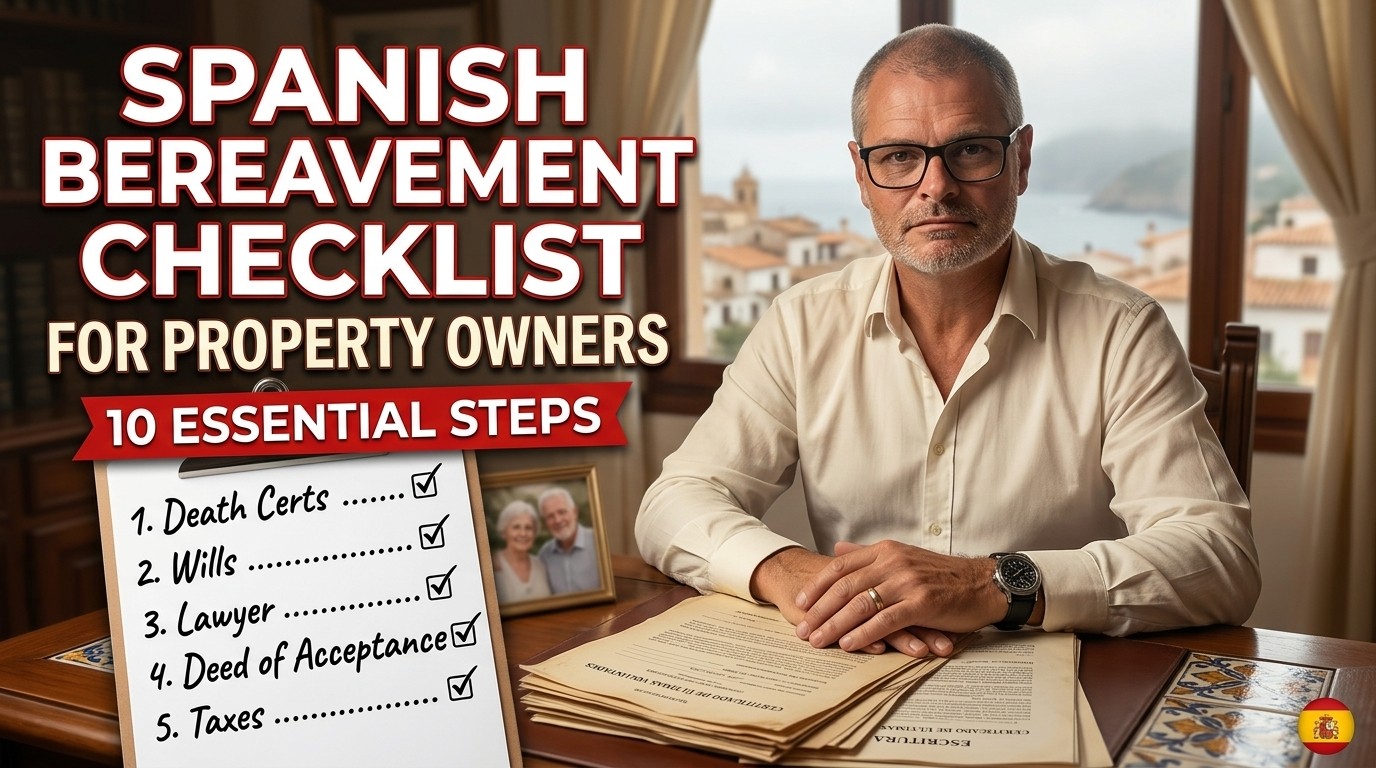
Bereavement Checklist for Property Owners in Spain
A simple guide for non-resident property owners following the death of a spouse

We are very sorry for your loss. The following steps outline the typical process required in Spain to transfer ownership of a property and organise practical matters after the death of a spouse.
1. Obtain Death Certificates
You will need several official copies of the death certificate issued in the country where the death occurred (for UK deaths, from the General Register Office).
These certificates will normally need:
- A Hague Apostille
- An official Spanish translation
Your lawyer or gestor can arrange the translation.
2. Confirm Whether a Spanish Will Exists
If the deceased made a Spanish will, the process is usually simpler.
A lawyer will obtain the Certificate of Last Wills (Certificado de Últimas Voluntades) to confirm whether a will was registered in Spain and which notary holds it.
If there is no Spanish will, the estate may be handled using the UK will or UK inheritance rules.
3. Appoint a Spanish Lawyer or Gestor
A Spanish lawyer will normally assist with:
- inheritance documentation
- tax declarations
- property registration
- communication with banks and authorities
This makes the process significantly easier for non-residents.
4. Prepare the Deed of Acceptance of Inheritance
The lawyer will prepare a document called:
“Escritura de Aceptación de Herencia” (Deed of Acceptance of Inheritance)
This document:
- identifies the heirs
- lists the assets (such as the property)
- confirms who inherits the property
It is signed before a Spanish Notary.
5. Pay Spanish Inheritance Tax
Spanish inheritance tax must normally be declared within 6 months of the date of death.
An extension of another 6 months can be requested if needed.
For spouses in the Valencian Community, significant tax reductions often apply.
6. Register the Property in the Land Registry
Once the inheritance deed is signed and taxes are paid, the property will be registered in the name of the heir at the:
Registro de la Propiedad (Land Registry)
After registration, the property will legally appear in the new owner’s name.
7. Update Property Tax Records
The property ownership should also be updated with the:
Catastro (Property Tax Authority)
This ensures future local property tax bills (IBI) are issued in the correct name.
8. Notify Banks
If the deceased held Spanish bank accounts, the bank will require:
- death certificate
- identification of heirs
- inheritance documentation
Banks may temporarily restrict access to accounts until the inheritance process is completed.
9. Transfer Utilities and Services
Once ownership has been clarified, the following should be updated:
- Electricity supply
- Water supply
- Internet / telephone
- Refuse collection
- Community fees (if applicable)
- Alarm systems
Usually this only requires identification, bank details, and a copy of the title deed.
10. Update Insurance Policies
Inform the property insurer so the policy can be transferred into the new owner’s name.
This ensures the property remains fully insured.
11. Consider Making a Spanish Will
Once the inheritance is completed, it is highly advisable for the new owner to make a Spanish will.
This simplifies the process for heirs in the future and is usually quick and inexpensive when done through a Spanish notary.
We Are Here to Help
If you need assistance with lawyers, paperwork, utilities or local administration, we are happy to help guide you through the process.
Please do not hesitate to contact us if you have any questions.
 Go back
 Buying Post BREXIT
 Buying in Spain in 10 steps
 Presenting Your Villa for Sale